
Blog

From Chaos to Calm: A Review of ClickCoach.io for Growth‑Minded Coaches

If you’re an up‑and‑coming life coach, you probably didn’t become a coach so you could spend your days chasing invoices, digging for session notes, and wondering where your clients actually stand with their goals.

You became a coach to transform people’s lives.

Quick note for transparency: I haven’t used ClickCoach.io in my own coaching business yet. I first discovered it in a webinar and I’m considering trying it myself. I’m sharing what I’ve learned so far in case you’re looking for a way to reduce admin chaos in your own practice.

Disclosure: This article contains affiliate links. That means if you decide to try ClickCoach.io through one of my links, I may earn a commission at no extra cost to you. I only share tools that I genuinely believe could help coaches create more peace and less chaos in their lives and businesses.

But once you get beyond a handful of clients, the reality hits:

  • Spreadsheets, Google Docs, and random apps start to run your life
  • You’re constantly context‑switching between tools just to stay organized
  • You feel like you’re doing great work, but you can’t clearly show progress in a way that justifies higher fees

That’s exactly the gap ClickCoach.io is trying to solve: one platform that takes you from onboarding to invoicing to accountability — so you can track results, raise your rates, and scale without drowning in admin.

In this review, we’ll walk through what ClickCoach.io actually does, how its features map to real coaching problems, where it falls short, and who it’s really for.

 The Real Problem: You Can’t Scale Chaos Most life coaches hit a predictable ceiling.

You’re delivering powerful sessions, clients love you, but:

  • Every new client means more manual admin
  • There’s no standardized process — each client gets a slightly different experience
  • You can’t prove outcomes with clear metrics, so charging premium fees feels scary
  • You’re always “catching up” on notes, billing, and scheduling instead of focusing on coaching

It’s not that you’re bad at business. It’s that your systems were never built to support a real coaching company — just a handful of clients.

ClickCoach.io is designed specifically for professional life coaches who want to step into that “business owner” identity: clear programs, measurable client outcomes, and an operation that doesn’t fall apart when you add 5, 10, or 50 more clients.

 What Is ClickCoach.io?

ClickCoach.io is an all‑in‑one coaching platform built for professional life coaches who want to:

  • Track measurable client progress
  • Eliminate admin chaos
  • Deliver a consistent, branded coaching experience
  • Confidently raise their rates and scale

One important detail: ClickCoach.io was built by the former CEO of a $30M coaching business that partnered with Tony Robbins. That matters because the platform isn’t theory. It’s modeled on systems that have already scaled at a high level.

The price point is $497 per year, which places it firmly in the “serious business tool” category — not a casual app you pick up and forget about.

 How ClickCoach.io Features Map to Your Real‑World Problems

Let’s go beyond buzzwords and connect features to what you’re actually struggling with day to day.  

1. Built‑In Goal Dashboards: Finally Make Progress Visible

Most coaches rely on feelings and anecdotes to measure outcomes:

  • “I think my client is doing better.”
  • “She says she feels more confident.”

That’s great — but it’s not enough when you want to:

  • Justify higher fees
  • Retain clients longer
  • Differentiate yourself in a crowded coaching market

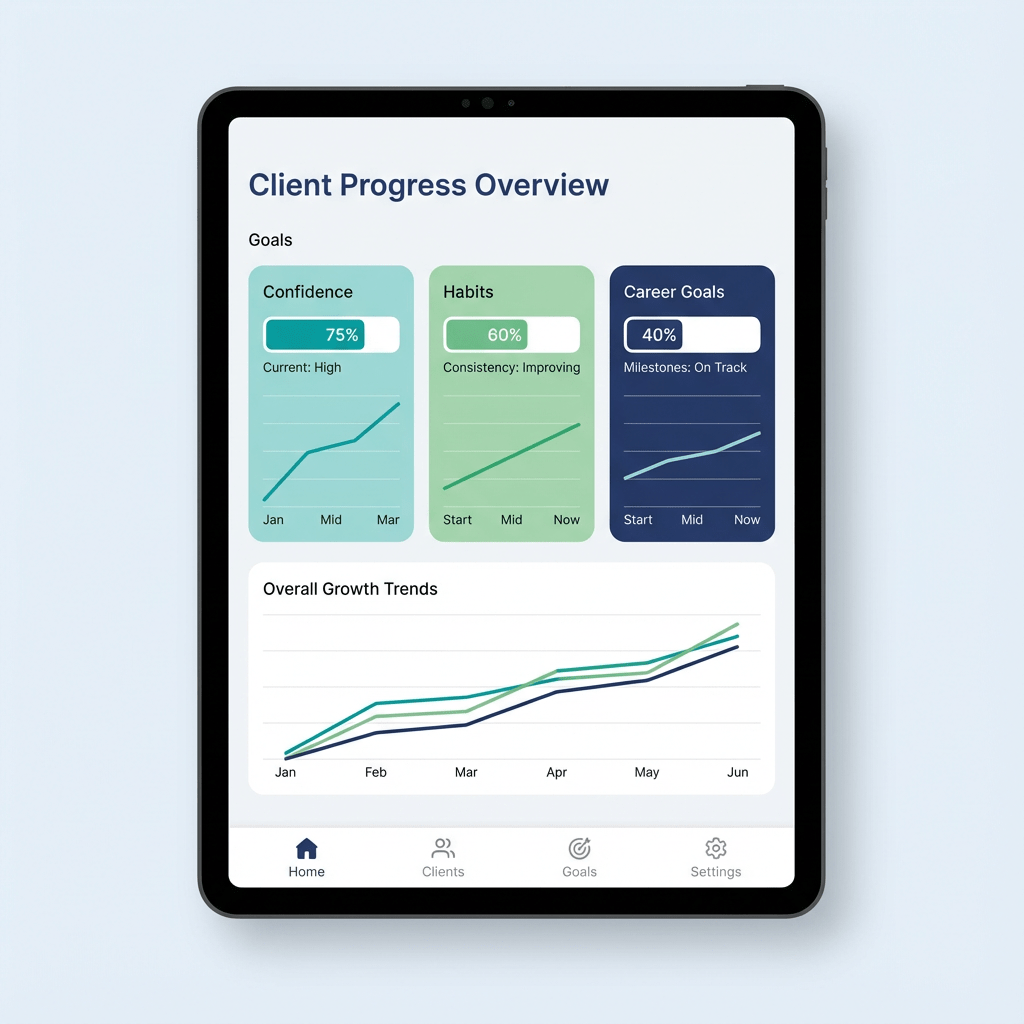
ClickCoach.io comes with built‑in goal dashboards that let you set clear, measurable objectives with your clients and track them over time. That means you can:

  • Define specific milestones (e.g., habits, actions, KPIs)
  • Log progress session by session
  • Show visual proof of improvement over weeks and months The impact?
  • Clients stay more engaged because they see their transformation
  • Renewals and referrals become easier (“Look how far you’ve come in 90 days”)
  • You have concrete evidence to back up higher‑ticket packages and premium pricing

Instead of vague “breakthroughs,” you become the coach who delivers tangible, trackable results.   

2. All‑in‑One Scheduling, Notes, Billing & Reports: Kill Admin Chaos

Here’s the typical tech stack of a growing life coach:

  • Calendly (or similar) for booking
  • Zoom links scattered across emails
  • Notes in Google Docs or paper notebooks
  • Invoicing through PayPal, Stripe, or manual invoices
  • Spreadsheets for tracking sessions and payments Every tool alone is fine. Together, they create chaos:
  • You waste mental energy switching systems
  • Things fall through the cracks (missed invoices, late notes, forgotten follow‑ups)
  • Nothing gives you a clean, bird’s‑eye view of your practice ClickCoach.io centralizes the operational side of your coaching business:
  • Scheduling: Book, manage, and track sessions in one place
  • Notes: Session notes are linked directly to each client and their goals
  • Billing: Handle invoicing and payments inside the same platform
  • Reports: See at a glance who’s on track, who’s behind, and how your business is performing

Instead of managing your business in five different tabs, you live in one dashboard. Less friction for you. Less chance of things slipping for your clients.  

3. Structured, Branded Coaching: Look (and Operate) Like a Premium Coach

If you’re honest, you might recognize this pattern:

  • Each new client gets a slightly different flow
  • You’re reinventing exercises and homework on the fly
  • Your “brand” is mostly your personality… not a cohesive, repeatable client experience This makes it hard to scale — and hard to charge more.

ClickCoach.io is built to help you deliver structured, branded coaching programs:

  • Create consistent program flows (onboarding → sessions → checkpoints → completion)
  • Share branded materials and workflows through a unified client experience
  • Reduce the mental load of “what should we do next?” because your process is already laid out To your clients, this communicates:
  • Professionalism
  • Reliability
  • High perceived value

You stop looking like “a nice person who gives advice on Zoom” and start looking like a true professional partner in their transformation. That shift alone can justify a move from mid-range pricing to premium packages.

 4. Built by the Former CEO of a $30M Coaching Business

Many coaching tools are built by software companies who don’t really understand what it’s like to:

  • Run a coaching practice at scale
  • Manage multiple coaches and clients
  • Balance transformation with operations

ClickCoach.io founder comes from a $30M coaching business that partnered with Tony Robbins. That background tends to show up in two ways:

  1. Feature choices: The platform is designed around what actually matters in a coaching business — client results, retention, and streamlined operations — not just shiny objects.
  2. Scalability: The system isn’t just for “one‑person and a few clients.” It’s built with the assumption that you want to grow. For a professional life coach looking to build a real business (not a side hustle), this perspective is a major plus.

Who ClickCoach.io Is (and Isn’t) For

To be blunt, ClickCoach.io is not for everyone.

ClickCoach.io is ideal for you if:

  • You’re a professional (or very serious aspiring) life coach
  • You already have paying clients, or a clear plan to get them
  • You’re tired of juggling tools and want one central operating system
  • You’re ready to deliver more structured, high‑end coaching and eventually raise your fees

ClickCoach.io is probably not the best fit if:

  • You’re brand new, with no clients and no immediate plan to find them
  • Coaching is a hobby, not a serious business
  • You’re not ready to invest $497/year into your infrastructure
  • You prefer improvisational, unstructured sessions and don’t want to systemize anything

In other words: ClickCoach.io is for life coaches who are ready to behave like business owners, not just practitioners.

 Honest Drawbacks & Limitations

To build real trust, we need to talk about where ClickCoach.io may not be perfect.  

1. The Price Point: $497/Year Is a Real Investment

For a brand‑new coach, $497/year can feel steep.

You’ll naturally ask yourself: “Can I justify this?”

If you’re still figuring out your niche, have no marketing pipeline, and just hope clients will appear, then no — this probably isn’t the best use of your money yet. But if you:

  • Have (or reasonably expect) a handful of paying clients
  • Intend to keep coaching for the long term
  • Want to raise your rates, improve results, and create a scalable structure

Then $497/year is often easier to justify. One retained client or one upgraded package can more than cover the cost. Still, the price is a real barrier for hobbyists and early beginners, and it’s worth acknowledging that.

 2. There Will Be a Learning Curve

ClickCoach.io consolidates scheduling, notes, billing, reporting, and accountability into one system. That’s exactly what makes it powerful — and what guarantees there will be some setup time. You’ll likely need to:

  • Define your core coaching programs and map them into the system
  • Set up your goal dashboards and progress metrics
  • Migrate notes, scheduling, and billing into ClickCoach.io

If you’re expecting to sign up today and have everything magically perfect tomorrow, you’ll be disappointed.

Think of ClickCoach.io less as an app and more as your coaching operations backbone. There’s an upfront lift, but it pays off with every new client you onboard afterward.

 3. It’s Not a Marketing or Lead Generation Tool

ClickCoach.io focuses on delivery, operations, and client results — not on finding you new clients. You’ll still need:

  • A way to generate leads (content, referrals, networking, ads, etc.)
  • A simple website or landing page
  • Potentially an email marketing tool for nurturing prospects

If you’re hoping for an “all‑in‑one everything” that does both marketing and operations, you’ll still want at least one separate marketing tool. ClickCoach.io lives on the delivery side of your business.

 So… Is ClickCoach.io Worth It?

If you strip away the hype, here’s the core question:

  • “Will ClickCoach.io help me run a more professional, scalable, and profitable life coaching business — enough to justify $497/year?” From what it’s designed to do, the answer is:
  • Yes — if you already have (or are close to having) paying clients and you’re serious about turning coaching into a professional, scalable business
  • Probably not yet — if you’re completely brand new, testing the waters, or not ready to systemize and commit ClickCoach.io shines when you:
  • Want clear, visual proof of client progress
  • Are tired of juggling tools and manual admin
  • Are ready to deliver a structured, branded coaching experience
  • Intend to raise your fees and grow without burning out

If that sounds like you, then ClickCoach.io can be less an “expense” and more like the infrastructure that supports the next level of your coaching career.

 Your Next Step

If you’re a professional (or soon‑to‑be professional) life coach who:

  • Has real clients or a clear path to getting them
  • Is done tolerating tech chaos and wants a true operations hub
  • Wants to confidently raise rates by backing your work with measurable results

…then ClickCoach.io is absolutely worth a serious look. Your next move:

Check out ClickCoach.io for yourself, review the features, and decide if now is the right time to upgrade your coaching infrastructure.

Click here to explore ClickCoach.io and see if it fits your practice.

A father figure kneels behind his young son a sunlit street, demonstrating gentle care and guidance.

Dads Are Needed in the Fight Against Domestic Violence

Why a Father’s Role is Critical in Domestic Violence Awareness Month

October is Domestic Violence Awareness Month, a critical time when the nation focuses its attention on the silent epidemic of abuse that affects millions of families. When we talk about this issue, the conversation often—and rightly—centers on the victims and the essential services survivors need. However, to truly eradicate domestic violence, we must shift a significant portion of our focus to prevention, and that is a job that cannot be done without men.

Specifically, it cannot be done without fathers.

For too long, the narrative around domestic violence prevention has been delegated to women’s organizations, law enforcement, and therapists. While their work is heroic, it is insufficient to tackle the root causes. The truth is, domestic violence is not a “women’s issue”; it is a societal crisis rooted in control, entitlement, and learned behavior—all things that fathers, in their unique and powerful position, have the power to dismantle. An estimated 15.5 million children in the U.S. are exposed to intimate partner violence annually, making the home a warzone for millions of youth.

This is a call to action for every father, stepfather, and male mentor: your presence, your voice, and your example are the most powerful tools we have in this fight. This Domestic Violence Awareness Month, we must stop seeing ourselves as mere bystanders and step up as the primary agents of change. From the quiet lessons taught at the dinner table to the difficult, necessary conversations with friends, fathers play a critical role in breaking cycles of violence and reshaping the future of family safety.

This article explores the immense power fathers hold in prevention, how to recognize the crucial teaching moments, and what active, engaged fatherhood looks like when confronting the uncomfortable reality of abuse.


How Fathers Break the Cycle of Violence: Modeling Healthy Conflict and Respect

A diverse couple sits calmly on a sofa discussing something on a tablet, showing active listening and partnership. Their two young children are playing or doing small chores on the floor in front of them. The image illustrates parents modeling healthy conflict resolution and equity in the home, which is key to domestic violence prevention.

The single most powerful act a father can perform in the fight against abuse is to live a life of respect and equity. Abuse is fundamentally about a power imbalance—a sense of entitlement to control another person’s mind, body, or spirit. The home is the first classroom where children learn what love, respect, and conflict resolution look like. The lessons learned here dictate whether a child will become a future abuser, a future victim, or a future champion of healthy relationships.

Fathers play a critical role in breaking cycles of violence that have often been passed down through generations. A son who grows up seeing his father dismiss, demean, or control his mother, partner, or sister learns a harmful script. He learns that anger justifies aggression and that control is a natural component of love. In fact, research shows that boys who witness domestic violence are twice as likely to abuse their own partners and children when they become adults.

Conversely, a son or daughter who watches a father embody healthy masculinity—one rooted in emotional intelligence, respect, and vulnerability—learns that true strength is the ability to de-escalate, apologize, and treat a partner as an equal.

For daughters, this is critical: a father’s treatment of her mother or partner sets the conscious and unconscious standard for what she will accept from men in her own future relationships. By modeling respect, you teach her her worth.

The Power of Healthy Conflict

Modeling respect and healthy conflict teaches kids what love should look like. Many children of divorce or high-conflict homes will later admit they didn’t learn how to fight, only that fighting was destructive. A healthy relationship is not one without disagreements; it’s one where disagreements are handled with dignity.

Fathers should actively demonstrate:

  • Active Listening: Truly hearing a partner’s perspective, even when you disagree.
  • De-escalation: Knowing when to take a break from an argument before emotions run too high.
  • Accountability: Admitting when you are wrong and offering a genuine, unreserved apology.
  • Emotional Regulation: Managing frustration without resorting to yelling, name-calling, or intimidation.

By prioritizing this emotional literacy and demonstrating partnership, fathers don’t just protect their current family; they inoculate the next generation against the impulse of abuse. This proactive work is the core of domestic violence prevention.


Domestic Violence Prevention Starts at Home: Everyday Choices for a Safe Family

The grand, sweeping gestures are often what we remember, but the true work of prevention is found in the mundane and the minute. Domestic violence prevention starts with everyday choices at home. These are the small, consistent decisions that build a culture of safety, trust, and equality within your family unit.

Fair Play and Equity

Does your daughter watch you equally share household chores and parenting duties with your partner? Or does she see you treat the domestic space as your partner’s domain? For stepfathers, grandfathers, and non-biological partners, this modeling of equity is even more profound; you demonstrate how a man enters an established home with respect, demanding neither control nor unquestioning deference, but full partnership. This small, daily act reinforces that all people, regardless of gender, deserve to be respected and have their contributions valued.

Challenging Harmful Language

Fathers must become vigilant editors of the language used in their homes and by their children. This includes:

  • Challenging Misogyny and Sexism: Intervening immediately when a child uses a derogatory term toward women or dismisses a girl’s ability based on gender.
  • Teaching Consent: Starting age-appropriate conversations early about bodily autonomy. Teaching children that yes means yes and no means no, and that their body belongs only to them—and the same is true for others.
  • Refusing to “Man Up”: Rejecting the cultural expectation that men must suppress vulnerability, sadness, or fear. Encourage emotional expression in your sons and daughters; this teaches them that they can handle their feelings without resorting to external aggression or control.

This intentional, daily practice of healthy parenting lays the foundation for a world where violence is unthinkable, demonstrating that a safe family environment is built on mutual respect, not fear.


Dads: Why Silence Equals Complicity in the Fight Against Abuse

The fight against domestic violence extends beyond the four walls of your home and into your wider community, your social circle, and your workplace. Here, your role shifts from model to active defender.

Silence equals complicity—dads must speak up and intervene. This is perhaps the hardest, but most vital, part of a father’s role in prevention. When a friend makes a joke about hitting his partner, when a colleague speaks of his wife in a degrading way, or when you notice troubling signs of controlling behavior in a family member’s relationship, your immediate response matters.

The risk of stepping in is real, but the cost of standing by is far greater. When a group of men lets a sexist comment or a threat of violence slide, they are, in effect, sanctioning that behavior. They are confirming the belief that these actions are acceptable within the culture of healthy masculinity.

How to Intervene Safely and Effectively

Intervention does not always mean a dramatic confrontation. It often means a measured, courageous conversation:

  • The Direct Challenge: “Hey, that’s not cool. Don’t talk about your wife like that.” or “That joke isn’t funny and it promotes violence.”
  • The Private Conversation: Pulling a friend aside later: “I’ve noticed you getting really angry with [Partner’s Name] lately. I’m worried about you and about her. Can we talk about what’s going on?” This opens a door for help and accountability without a public shaming that can lead to defensiveness.
  • The Bystander Mobilization: If a situation is actively unsafe, calling for help (like 911) or enlisting others to help de-escalate. Safety is always the priority.

As fathers, we teach our children to stand up to bullies. It is time we teach ourselves to do the same for our peers. Healthy masculinity demands courage, and courage demands breaking the silence.


Supporting Survivors and Demanding Accountability: A Father’s Response to Abuse

When abuse comes to light, whether it’s a family member, a friend, or an acquaintance, a father’s response is a critical test of his values.

An adult male ally sits with a survivor (represented by an adult male or female figure) who is confiding in him. The ally is listening intently with an empathetic, non-judgmental expression. The image represents a father's role in listening to survivors and providing support without judgment.

Responding well means supporting survivors, not excusing those causing the harm. The instinct to protect “the guy” in your social circle can be strong, but it is an instinct that must be overcome. When we excuse abuse with phrases like “He was stressed,” “She pushes his buttons,” or “He’s really a good guy otherwise,” we are contributing to the culture that allows violence to flourish.

A Father’s Guide to Supporting Survivors

If a survivor confides in you, your job is simple: believe them, affirm them, and connect them with professional help.

  • Listen Without Judgment: Do not grill them for details, blame them for staying, or criticize their past choices. Say, “Thank you for trusting me. I believe you. This is not your fault.”
  • Resource Connection: Know the resources. A father’s best role here is not to be a counselor, but a bridge to professional help. For specialized guidance on supporting children impacted by abuse, reach out to resources like the National Domestic Violence Hotline (1-800-799-SAFE).
  • Respect Their Agency: Let the survivor dictate the next steps. Do not pressure them to leave, confront the abuser, or report the incident. Your role is to support their safety plan, whatever that may be.

Demanding Accountability

True allyship for survivors requires demanding genuine accountability from the person who caused harm. This means:

  • Refusing to Socially Isolate the Survivor: Do not drop a survivor from your social circle out of discomfort.
  • Refusing to Socially Reintegrate the Abusive Partner: Do not immediately welcome an abuser back into the social fold without clear evidence of long-term change, deep remorse, and successful completion of a certified batterer intervention program. Real accountability is hard work and requires proof, not just promises.

By holding friends and family to a higher standard, fathers help establish that abuse is not a mistake to be brushed aside, but a serious choice that carries consequences.


Conclusion: The Legacy of a Respectful Father

Domestic Violence Awareness Month is more than just a 31-day campaign; it is a permanent commitment. For the fathers reading this, your challenge is clear: you are not just raising children; you are shaping future partners, neighbors, and citizens. The peace and safety of the next generation depend on the lessons you model today.

Fathers play a critical role in breaking cycles of violence—a role that demands courage, vulnerability, and unwavering respect. Remember: domestic violence prevention starts with everyday choices at home. Choose equity. Choose respect. Choose to speak up when silence equals complicity. And always choose to support the courageous, not excuse the cruel.

When your children, years from now, reflect on their father, let them remember a man who stood for fairness, spoke against injustice, and demonstrated that love is partnership, not possession. That is the ultimate legacy of a respectful father, and the most powerful blow against domestic violence.

Call to Action: Be the Change, Today.

Do not let this October end without taking a tangible step.

  • Educate Yourself: Learn the signs of abuse beyond physical violence (financial, emotional, technological). Visit the National Domestic Violence Hotline website for resources.
  • Talk to Your Kids: Initiate an age-appropriate conversation this week about modeling respect, consent, and healthy relationships. Use the resources on A Father Heard for conversation starters.
  • Get Involved: Support organizations that provide support for domestic violence survivors. Consider making a donation or volunteering time to a local shelter.
  • Join the Conversation & Commit: Share this article on social media and use the hashtag #AFatherHeardAgainstDV to encourage other fathers to step up. Your voice is needed. Your action is required. Let the powerful influence of a father be the turning point in the fight against abuse. Take the pledge to model respect and accountability this month with A Father Heard!

A blacksmith's hammer strikes a glowing piece of metal, with sparks transforming into the silhouette of a person. This symbolizes a person being forged and strengthened by pressure and hardship.

The Crushing of the Ego: Why Greatness is Forged, Not Given

Have you ever stopped to consider the journey of a single grape? In its plump and perfect form, it holds all the potential to be something magnificent. But that potential remains dormant until a violent, transformative act takes place. The grape must be crushed. Its skin must be broken, its sweetness released, and its essence pressed out under immense weight. Only then, through a process of fermentation and refinement, does it become something far greater than its original self: wine.

This is not a cruel act, but a necessary one. And in this process, we find a profound truth about the human spirit: you do not get greatness without the crushing of the ego.

The ego, like the uncrushed grape, is a fragile vessel of potential. It holds our pride, our insecurities, our vanities, and the comfortable story we tell ourselves. It whispers, “I am enough as I am,” and “I deserve this without the struggle.” It sees the world through the lens of its own perfection and resists any force that threatens to change it.

But true personal growth isn’t an acquisition to be added to our ego; it is born from its dissolution. We are not crushed to be broken, but to be stripped down to our truest, most resilient selves. This is the hard truth of the journey—a truth I’ve seen play out in my own life and in the stories of countless others on the path to personal development and long-term success.

A close-up, high-quality image of a single grape being crushed under a heavy stone press, symbolizing the crushing of ego for personal growth and success.

Pressure Strips Away Excuses: The First Step in Overcoming Challenges

The journey to true greatness begins when pressure forces us to be honest. We all have our excuses. For me, a naturally quiet and introverted person, I allowed that to be a significant hindrance in my professional life. I would pass on opportunities to utilize my voice—to lead a meeting or speak in front of a group—even when I was more than qualified to do so. I felt trapped in a self-imposed cage, a story I had allowed myself to believe about my own capabilities.

But pressure has a way of silencing all the “I couldn’t because” stories. It’s an honest and unforgiving force that strips away the rationalizations and gets you to the raw, honest facts. The moment of decision arrived when I had to confront the reality of my situation. I had to stop telling myself the story of being a “quiet person” and start confessing that I was an effective communicator. It was a terrifying but necessary leap of faith. The apprehension to speak in front of crowds became a lot easier once I faced my fear head-on.

An introverted man stands confidently with a microphone, speaking to a small, engaged crowd. The image symbolizes a quiet person overcoming a fear of public speaking through personal growth and accountability.

This is the power of embracing pressure. It forces a complete and honest assessment of the situation: “What can I do right now, with exactly what I have, to get this done?” It moves you from a passive victim of circumstances to an accountable owner of your results. This radical shift in mindset for success is the first step in overcoming challenges.

The Forge of Discipline: From Talent to Mastery

Raw talent is a gift, but it is not a destination. Without discipline, talent is like a raw diamond—it has immense potential, but lacks the refinement to truly shine. The journey from talent to discipline is where personal growth truly takes shape.

Split image showing a rough, unpolished piece of wood on the left and a smooth, refined sculpture on the right. This visual metaphor illustrates the transformation of raw talent into disciplined mastery through challenge.

Think of it this way: talent can get you started, but patience is the mental muscle that keeps you in the fight. I once had a friend who wanted to speak at a big event, but because the deadline was too tight, I wasn’t in a place to pull it together. I knew I couldn’t deliver my best work, and I didn’t want to force it. My friend felt like I left money on the table. But I had the patience to not rush a process that needed time to mature. A year later, the very same opportunity came back around. Guess what? I nailed it!

That was a lesson in the difference between being a talented person and a refined one. The talented person might have jumped at the opportunity and delivered a mediocre performance. But the refined individual, forged by experience, understands that patience under pressure is a strategic asset. The journey from talent to mastery is the conscious choice to be forged in the fire of challenge, rather than to remain a beautiful but brittle artifact. This is the essence of true mental toughness.

The Gift of Humility: The Humbling That Leads to Elevation

One of the most transformative gifts of pressure is not what it gives you in the moment, but what it strips away. Arrogance is a thin skin of false confidence, a protective layer we build to avoid confronting our limitations. Pressure, like a high-intensity laser, burns that layer away. It forces a moment of truth, a humbling encounter with your own true capacity.

Years ago, I felt that a specific job opportunity at work was “meant for me.” I was frustrated and disappointed when I didn’t get the role. That feeling of rejection was a humbling blow to my ego and my sense of entitlement. It was a painful moment that shattered a story I had told myself about my own destiny. But once I released that frustration—once I let go of the need for control and surrendered to a higher plan—a new door opened to me. That door led to what I’ve been doing for the last decade.

The process is always the same: pressure humbles, humility grounds, and a grounded foundation is what allows for true elevation. You can’t reach a new height until you acknowledge where you truly stand. This is a vital lesson in leadership development and how to deal with frustration.

The Path of Purpose: Why Faith Forges Strength

Perhaps the most crucial differentiator between those who are broken by pressure and those who are forged by it is a deep-rooted sense of purpose. For many, the pain of the pressure outweighs the value of the goal, and they are fighting for a surface-level prize. But for the rare few who endure, the pressure is merely the price of admission to something they believe in.

For me, that deep-rooted purpose comes down to my faith. I know that God has me exactly where He desires for me in due season. Even as I’m in the midst of a layoff, my thought process is, “What’s for me is for me!” My focus is to stay sharp and maintain my readiness until the time is right.

This Christian perspective on success provides an unshakeable sense of calm in the face of chaos. It’s a mindset that allows me to see a layoff not as an end, but as a disruption that forces a more strategic and resourceful response. It’s about letting go of the need for comfort and finding a new kind of comfort in my own ability to adapt and endure. The drive is no longer fueled by the avoidance of discomfort but by the pursuit of growth, mastery, and purpose.

The Master’s Journey: The Mark of True Mastery

I’ve been in the workforce since I was 17 years old. I’m 50 now. At this point, my focus is not on chasing titles or paychecks, but on finding the right place that aligns with who I am at my core. If that happens, the long-term journey of a career is a given.

This is the ultimate expression of mastery. It’s not a static state of perfection but a dynamic process of personal growth. Mastery is simply the accumulated evidence of surviving repeated cycles of pressure. It is the wisdom gained from decades of being humbled and then elevated. The expertise you possess is not just the sum of your skills; it is the hardened core of your professional self—the knowledge that has been tested and proven to work under every conceivable condition.

Your Call to Transformation

Just as the crushed grape releases its essence to become a more sublime form, so too are we refined by life’s pressures. The pain of the crush is not the end of the story; it is the beginning of a magnificent transformation.

Your personal development journey requires you to step into the press. Are you willing to be crushed? Are you ready to let go of your excuses and your ego so that you can become something truly great? The choice is yours. Embrace the pressure and prepare to be refined.

Resilient father in casual clothes standing at sunrise, holding coffee and looking toward the horizon, symbolizing hope and new beginnings after a job layoff.

Navigating Through the Uncertainty of a Job Layoff: A Father’s Perspective

When Work Stops, Fatherhood Doesn’t

On a Thursday, I learned I was being laid off in two months. By Monday, I realized I wasn’t just losing a job — I was losing a piece of the work I’d poured my heart into for over two decades.

When you’re a father, a layoff hits differently. The mortgage still needs paying. The fridge still needs filling. The little eyes at the dinner table still look to you for reassurance.

Job loss can feel like a threat to more than your bank account — it can feel like a threat to your identity. But here’s the truth: a layoff is not the end. It’s a forced reset, a chance to rebuild with intention.

I found out that our team was being laid off, and it was a shock. We had worked tirelessly to meet the needs of the families we served. But it wasn’t until I returned from PTO and read our Executive Director’s words about the impact we had made over ten years that it really began to sink in. We had touched countless families and individuals — and now there would be a void in our community.

That day, I realized layoffs don’t just affect paychecks. They ripple into the lives of others, and as a father, that weight feels even heavier.


The Emotional Reality of a Layoff

For many fathers, a layoff is more than the loss of a paycheck — it’s the loss of a role, a rhythm, and a sense of stability. It can stir up fear, shame, and uncertainty.

For me, the emotion that hit hardest was grief. This wasn’t just any job ending — I had served in that agency for over 22 years. I had helped build the fatherhood program from the ground up, and I’d walked alongside countless fathers as they worked to better their lives. Suddenly, it was gone, and I was left asking, What’s next for me?

Close-up of a father’s hands resting on a kitchen table beside a notebook and coffee cup, reflecting on life changes after job loss.

Almost immediately, I began looking inward: What am I passionate about? How can I turn this into an opportunity? That’s when I started sharing my layoff journey on social media, leaning into the work I’d been building outside my 9–5 in the fatherhood space. I made a decision — I wasn’t going to just settle for anything.

I’ve had honest conversations with my kids and family. I’ve reminded them (and myself) that things will change, but things will be okay. I have faith in the Most High. When one door closes, another always opens.


Core Mindset Shift — You Are Not Your Job

When a layoff happens, it’s easy to let your career status define your worth. But here’s the truth: your kids don’t care what’s printed on your business card. They care about how you show up.

If I were sitting across from a dad who just lost his job, I’d tell him: Your story is still being written. You are not a failure. This is not the time to lay down. This is the time to do the things you’re passionate about, to tap into your purpose, and to leave no stone unturned.

Father smiling warmly while talking with teenage child over breakfast, showing connection and encouragement during a career transition.

Your worth as a father is not tied to your job title. You are so much more than the work you do. Keep being the best you can be for your family, because they’re watching how you handle this moment — and they’ll remember your resilience more than any paycheck.


The Power of Structure in Uncertain Times

When life feels uncertain, structure becomes your anchor. Without it, days can blur together and motivation can fade fast.

After my layoff, I made it my goal to wake up at the same time every day and follow my morning routine. I start with quiet time — grounding myself before the day begins — then I help my daughter with her schooling. I’m intentional with my hours and don’t allow my hands to be idle.

Open journal, pen, and laptop on a clean desk near a sunny window, representing focus and daily routines during a job search.

My focus is split between personal development, building my fatherhood work, and searching for job opportunities that align with my values. And here’s the truth: I work harder on myself than I ever did on my job. That daily discipline keeps me steady and moves me closer to what’s next.


Using the Layoff as a Launchpad

A layoff can close one door — but it can also clear the space for new ones to open. If you choose to see it that way, it can be a season of creativity, focus, and forward motion.

When I got my notice, I made a decision: I wasn’t going to wait for an employer to validate my calling. I started writing for my blog again, creating meaningful posts to remind fathers how important they are. I didn’t need a job to do that — it’s been part of me for over 11 years.

Confident father speaking to a small group in a community center, sharing ideas and building opportunities in fatherhood work.

I’ve been working on several projects, crafting presentations, and pursuing opportunities to expand the work of fatherhood. And the more I’ve poured into this mission, the more doors have opened. This isn’t just about bouncing back — it’s about building something that lasts.


5 Ways Fathers Can Stay Strong During a Layoff

  1. Stick to a Routine – Keep waking up at the same time, staying active, and structuring your day.
  2. Have Honest Family Conversations – Transparency builds trust and helps your loved ones adjust with you.
  3. Reconnect with Your Purpose – Use this time to focus on what you’re truly passionate about.
  4. Invest in Personal Growth – Read, learn, and develop yourself so you’re ready for the next opportunity.
  5. See It as a Launchpad – Your next chapter might be better than you imagined.

A Broader Perspective

Research from the American Psychological Association shows that job loss can significantly increase stress levels and impact family relationships. But studies also show that resilience — the ability to adapt and bounce back — is a skill that can be strengthened.

Your children are watching how you respond in this season. By staying calm, consistent, and committed to growth, you’re modeling resilience that will serve them for life.


Final Thoughts — From Setback to Setup

To my fellow fathers walking through a layoff: you are more than your job. This moment is not the end of your story — it’s the beginning of a new chapter.

Lean on your faith. Be honest with your family. Create a daily structure that keeps you moving. Use this time to pour into the things you care about most. And remember: the way you respond now is shaping not only your future, but the way your children will approach challenges in their own lives.

One door has closed, but others are opening. Step through them with courage.


If you’re a father navigating change, I share encouragement, tools, and real stories at A Father Heard. Let’s walk this journey together.

Twilight path through trees symbolizing a father’s faith journey in uncertain times”

Why Stay Here Until We Die? A Father’s Step Into Purpose

How a season of transition reawakened my calling and redefined my leadership as a father

Every father has felt it — that late-night moment when responsibilities pile up and fears whisper louder than your courage. You’re not alone. Centuries ago, four outcasts in 2 Kings 7:3-10 faced a similar crossroads. Starving and ignored, they chose to act, saying, “Why stay here until we die?” Their boldness didn’t just save their lives — it rescued an entire nation.

Today, fathers face less literal but equally paralyzing “lepers”: procrastination, financial stress, unresolved relationships, or the fear of not measuring up. We bury these struggles, hoping they’ll vanish. But like the lepers’ untreated wounds, ignored problems only fester. This article isn’t about condemnation — it’s about liberation. Through the lens of an ancient story, we’ll explore how embracing imperfect faith and decisive action can transform your leadership at home.

Understanding the ‘Leper’ in Our Lives

A single figure at the start of his journey into the unknown.

In biblical times, leprosy wasn’t just a physical disease — it was a social death sentence. Lepers were cast out, avoided, and left on the fringes of society. For fathers today, the “leprosy” we deal with isn’t visible on the skin — it lives in silence, procrastination, shame, or fear. It keeps us spiritually stuck and emotionally distant. It whispers: You’ll never get ahead. You’re failing. You’re not enough.

So what is your “leper”?

Maybe it’s time — the way it seems to vanish no matter how well you plan. Maybe it’s money — feeling like you can never quite catch up. Or maybe it’s deeper: anger you’ve never dealt with, trauma you’ve never named, a spiritual rut you’ve come to accept. These hidden “lepers” don’t just affect you. They show up in your tone, your energy, your decisions, and ultimately, in the way you lead your family.

The danger isn’t always in the size of the problem. Often, it’s in how long we’ve ignored it. Because what we avoid doesn’t go away — it grows. And what grows unchecked can dictate the direction of our lives. That’s why recognizing your “leper” is the beginning of breakthrough. You can’t fix what you won’t face.

But here’s the truth: You’re not disqualified because you’re struggling. You’re human. And like those four lepers sitting outside the gate of Samaria, you have a choice — stay in the mess or move toward something more.

Lessons from the Four Lepers of 2 Kings

The story of the four lepers in 2 Kings 7 isn’t just about desperation—it’s about radical clarity. These men sat outside Samaria’s gates during a famine so severe that mothers were eating their own children (2 Kings 6:28–29). As outcasts, they had nothing to lose. Yet in their darkest moment, they asked a revolutionary question: “Why stay here until we die?” (2 Kings 7:3–4)

Their logic was painfully simple: If they stayed, they’d starve. If they approached the enemy camp, they might die—or live. So they took a risk, stumbling toward the Arameans’ tents. But when they arrived, the camp was empty. God had miraculously caused the enemy army to flee, leaving behind food, supplies, and treasure (2 Kings 7:6–7). The lepers’ “crazy” decision didn’t just save them—it saved an entire city.

For fathers, this story cracks open three timeless truths:

  1. Inaction is a slow death. Staying stuck in fear, pride, or procrastination drains your ability to lead.
  2. Faith requires movement. The lepers didn’t wait for a guarantee—they stepped into the unknown.
  3. Your breakthrough isn’t just for you. Their courage fed a starving nation. Your choices today will impact generations.

Modern fatherhood is rarely about literal survival, but the same principle applies. When you avoid hard conversations, delay financial planning, or silence your spiritual hunger, you’re choosing the “slow death” of complacency. But when you act—even imperfectly—you open the door to provision you couldn’t foresee.

Evaluating Your Inner Circle and Taking Action

A group of men walking or talking together on a trail

Just as the four lepers made their decision together, your journey forward depends heavily on who walks beside you. The harsh reality? Some relationships keep us camping at the city gate, stuck in familiar pain. Others push us toward growth, even when that growth is uncomfortable.

The Power of Your Circle

Take a moment to consider: Who are the voices in your life? Are they men who challenge you to grow, or those who normalize staying stuck? The Scripture says, “Iron sharpens iron, and one man sharpens another” (Proverbs 27:17). But rust can’t sharpen anything. Your transformation begins with honest evaluation of your influences.

Consider these questions:

  • Who do you call when life gets hard?
  • Are your closest friends moving forward or standing still?
  • Do your relationships encourage faith or feed fear?
  • Who holds you accountable to your goals and values?

Taking Actionable Steps

Like the lepers, your journey starts with a single step. Here’s how to begin:

  1. Name Your “Leper”
    • Write down what you’ve been avoiding
    • Be specific about how it affects your family
    • Identify the cost of not changing
  2. Create Your Action Plan
    • Break down big challenges into smaller steps
    • Set realistic timelines for each step
    • Share your plan with someone who’ll hold you accountable
  3. Build Your Support System
    • Join a men’s group or Bible study
    • Find a mentor who’s overcome similar challenges
    • Connect with other fathers who share your values

Remember, movement doesn’t have to be massive to be meaningful. Sometimes the bravest step is making that first counseling appointment, opening that budget spreadsheet, or having that difficult conversation you’ve been avoiding.

Building Imperfect Yet Forward-Moving Faith

In our pursuit of growth, it’s easy to believe we need all the answers before we act. But the truth is, God never asked for perfection—He invites movement. The story of the four lepers reminds us that breakthrough often begins when we choose obedience over certainty. They didn’t have power or a well-defined plan. They just moved, trusting that something would meet them on the road.

Imperfect Faith is Still Faith

That truth came alive for me recently. A little under two months ago, I found out that I’ll be laid off at the end of August. In that moment, I had two choices: let fear set the agenda or start walking forward with faith.

I chose the latter.

I began documenting my layoff journey on social media, not for attention, but to reclaim my voice and remind myself — and others — that God still leads in the unknown. That simple act of transparency reopened the door to my passion for writing. I’ve started creating again, not as a side project, but as a calling. I know I can find another job, but during this transitional season, I’m choosing to work my passion like passion has never been worked before.

I’m not just doing this for myself or even just for my kids — I’m doing it for every father, every parent, silently facing uncertainty. You’re not alone. And while your faith may feel unsure or imperfect, every forward step is powerful. It proves to your family and to yourself that fear doesn’t have the final say.

an African father with a warm smile giving his young daughter a hug

Conclusion: Leading by Example

Fathers, your family isn’t looking for perfection — they’re looking for presence, courage, and consistency. Leadership at home starts by modeling what it means to face obstacles head-on, to own your weaknesses, and to move forward in faith even when the outcome is unclear.

The four lepers didn’t have power, privilege, or a perfect plan — but they had the courage to ask, “Why stay here until we die?” That question, spoken in desperation, became the spark that saved a city. In the same way, your willingness to confront what’s holding you back can unlock healing, provision, and generational change in your home.

You’re not just leading your family with your words — you’re leading them with your steps. Every move you make toward wholeness, connection, and growth sends a strong message to your spouse, your children, and your circle: We don’t have to stay stuck. We can choose something better.

Let this be your moment to act. Your courage will create clarity. Your faith will inspire movement. And your decision to step forward — even if it’s small — might be the very thing that sets your entire family free.


Key Takeaways

  • Every father carries something that can hold him back — identify your “leper.”
  • Like the lepers in 2 Kings 7, you must choose movement over stagnation.
  • Evaluate your relationships and build a support system that sharpens you.
  • Faith doesn’t require perfection — it requires progress.
  • Your steps of courage ripple through generations. Lead by example.

Call to Action

What is one area in your life you’ve been avoiding that needs a step forward? Leave a comment below or message us privately — we’d love to support you.

If this message resonated with you, share it with another father who needs encouragement today. Together, let’s build a tribe of men who lead with honesty, faith, and action.

Download Your Free Reflection Tool and lead your home with the fruit that lasts with the Father’s Leadership Check-In. Reflection. Action. Legacy.

#afatherheard #leadwithfaith #dadlife #MenofGod #faithforward